
What Is Beekeeping: A Complete Beginner’s Guide to Apiculture
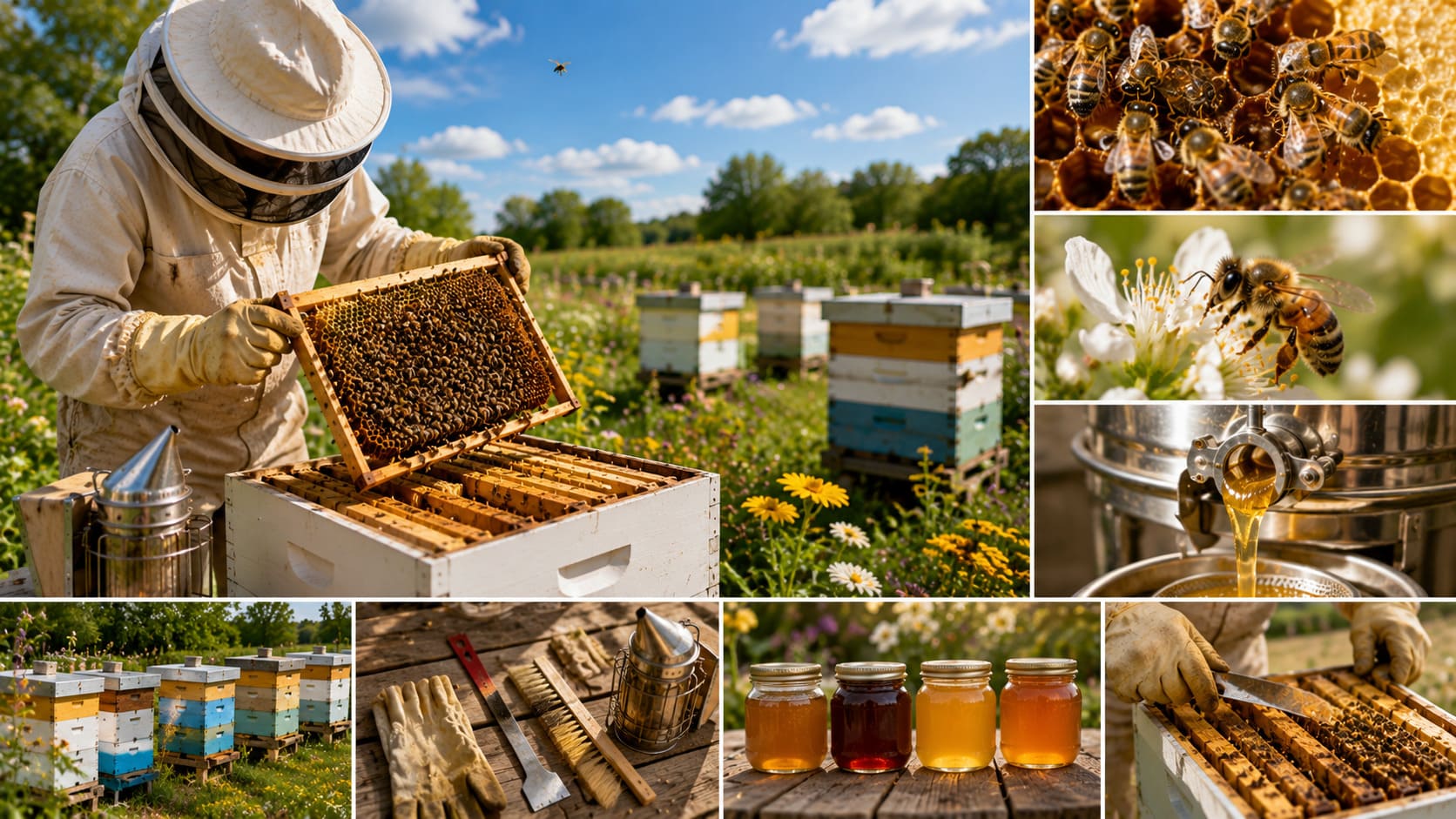
A beekeeper carefully inspects a frame from a healthy honey bee colony.
Beekeeping — or apiculture — is one of humanity’s oldest agricultural practices, stretching back more than 9,000 years to rock paintings discovered in Spain and Egypt. Yet today, it is experiencing a remarkable renaissance as farmers, environmentalists, hobbyists, and urban communities rediscover the profound value of maintaining healthy bee colonies. Whether you are drawn by the promise of fresh honey, a desire to support local ecosystems, or a passion for the science of social insects, understanding what beekeeping truly involves is the first essential step on your journey.
At Pollination Network, we believe that informed beekeepers make better beekeepers. This guide covers everything from the basic definition of apiculture to the daily responsibilities, the equipment needed, the seasonal rhythms, and the critical role these small creatures play in our food supply.
Defining Beekeeping: More Than Just Honey
Beekeeping is the art, science, and practice of maintaining honey bee colonies — typically within man-made hives — for the purpose of collecting honey, beeswax, propolis, royal jelly, and pollen, as well as providing pollination services to orchards, farms, and wild landscapes. The person who practices beekeeping is called a beekeeper or apiarist, and their collection of hives is known as an apiary.
While honey production is the most recognised benefit, experienced beekeepers will tell you that the true reward lies in the intimate relationship developed with a living colony of tens of thousands of highly organised insects. Each hive is a superorganism — a self-regulating community with its own communication system, division of labour, and collective intelligence that has evolved over 30 million years.
Modern beekeeping encompasses several distinct disciplines:
- Hobbyist or backyard beekeeping — typically 1–5 hives maintained for personal honey production and pollination of home gardens.
- Sideliner beekeeping — a part-time enterprise with 11–300 hives, generating supplementary income from honey sales and hive rentals.
- Commercial beekeeping — large-scale operations with hundreds or thousands of hives, often providing migratory crop pollination services across multiple states or countries.
- Conservation beekeeping — focused on maintaining genetically diverse, treatment-free colonies adapted to local conditions.
A Brief History of Beekeeping
The story of humanity’s relationship with bees is a story of ingenuity and mutual benefit. Ancient Egyptians kept bees in clay cylinders along the Nile Delta as early as 2400 BCE, and their hieroglyphic records describe sophisticated honey-harvesting techniques. Greek and Roman writers including Aristotle, Virgil, and Columella dedicated detailed chapters to the management of bee colonies, recognising their role in both food production and agriculture.
The great revolution in modern beekeeping came in 1851, when the Reverend Lorenzo Lorraine Langstroth of Pennsylvania discovered the concept of “bee space” — the 6–9 mm gap that bees maintain between combs and structures. This insight led directly to the removable-frame hive that bears his name and remains the global standard today. With the Langstroth hive, beekeepers could inspect individual combs without destroying the colony, monitor for disease, manage queens, and dramatically increase honey yields.
The 20th century brought further innovations: the honey extractor, foundation sheets for comb building, modern protective equipment, and scientific understanding of bee diseases and parasites. The 21st century has added electronic hive monitoring, genetic disease resistance breeding programmes, and a global movement to restore bee habitats in agricultural and urban landscapes.
Understanding the Honey Bee Colony
To become an effective beekeeper, you must first understand the social structure of the colony you are managing. A healthy honey bee colony in summer consists of:
- One queen — the sole reproductive female, capable of laying up to 2,000 eggs per day. She is identified by her elongated abdomen and the circle of attendant worker bees that constantly groom and feed her.
- 10,000–60,000 worker bees — infertile females who perform every task within the hive: nursing larvae, building comb, guarding the entrance, foraging for nectar, pollen, water and propolis, and maintaining hive temperature.
- 0–500 drones — fertile males whose sole purpose is mating with virgin queens from other colonies. They are expelled from the hive before winter when food stores become critical.
Worker bees progress through a series of roles determined by age. During their first three weeks of adult life they perform internal hive duties; in their final two to three weeks they become foragers, collecting the raw materials that the colony transforms into food stores. This division of labour is not directed by any individual — it emerges from complex pheromone signalling and behavioural thresholds that represent one of nature’s most elegant self-organising systems.
Essential Beekeeping Equipment
Starting a beekeeping operation requires a modest but specific set of tools. Cutting corners on equipment, particularly protective gear, is a false economy that leads to painful setbacks for both beekeeper and bees.
The Hive
The Langstroth hive remains the most widely used system worldwide and is the recommended starting point for beginners. It consists of a bottom board, one or two brood boxes where the queen lays eggs and the colony lives, honey supers where excess honey is stored, and a lid with inner cover. Alternative systems include the British National hive (common in the UK), the Warré vertical top-bar hive (popular with natural beekeepers), and the horizontal Kenya top-bar hive.
Protective Equipment
- Full suit or jacket with attached veil
- Leather or nitrile gloves
- Knee-length boots or tucked-in trousers
Tools
- Smoker — burns natural fuels (pine needles, wood chips, burlap) to produce cool smoke that masks alarm pheromones and prompts bees to gorge on honey, making them docile during inspection.
- Hive tool — a stainless steel pry bar for separating propolis-cemented components and lifting frames.
- Bee brush — a soft bristle brush for gently moving bees off frames during inspection.
- Frame grip — a spring-loaded device for safely holding frames single-handed.
Seasonal Beekeeping Calendar
Beekeeping is an inherently seasonal practice, and the beekeeper’s tasks shift dramatically with the calendar. Understanding these rhythms is fundamental to keeping healthy, productive colonies.
Spring: Build-Up and Swarm Prevention
As temperatures rise and the first flowers bloom, the colony shifts from winter cluster to rapid expansion. The queen begins laying at full capacity, and the population can double within weeks. This explosive growth triggers the colony’s primary reproductive behaviour: swarming. Half the colony — led by the old queen — leaves to establish a new home, leaving behind a new queen in the original hive. Beekeepers prevent unwanted swarms by ensuring the hive has adequate space, conducting regular inspections to find and remove or manage queen cells, and performing planned splits to simulate swarming in a controlled way.
Summer: Honey Flow and Monitoring
The main nectar flow — when flowers are producing abundant nectar — represents the period of maximum honey production. Beekeepers add honey supers, monitor for the presence of the queen, and test for Varroa mite levels. Varroa destructor, an external parasitic mite introduced to Western honey bees in the 1980s, is currently the single greatest threat to managed bee colonies worldwide.
Autumn: Preparing for Winter
Autumn management focuses on ensuring the colony has sufficient winter stores (typically 18–25 kg of honey), a healthy young queen mated in late summer, and a disease-free population. This is also the critical window for Varroa treatment, as reducing mite levels before winter brood ceases ensures a healthy cohort of long-lived winter bees.
Winter: Minimal Disturbance
In cold climates, the cluster forms and the beekeeper’s primary role is passive monitoring. Hives should be protected from wind and moisture, entrances reduced to prevent mouse ingress, and occasional hefting of the hive used to assess honey reserves without opening the brood box.
The Rewards of Beekeeping
Beyond honey — a product that ranges from the delicate white acacia honeys of Eastern Europe to the dark, complex heather honeys of Scottish moorland — beekeeping offers an extraordinary range of products and benefits:
- Beeswax — used in candles, cosmetics, wood polish, and pharmaceutical preparations.
- Propolis — the antimicrobial resin collected from tree buds, valued in natural medicine and food preservation.
- Royal jelly — a protein-rich secretion used to rear queens, prized in the health supplement industry.
- Pollen — harvested using pollen traps and sold as a nutritional supplement.
- Pollination services — renting hives to fruit growers and market gardeners, a growing income stream that connects beekeepers directly to agricultural communities.
Challenges Facing Today’s Beekeepers
Modern beekeeping is not without its difficulties. Colony Collapse Disorder (CCD), first identified in North America in 2006, brought worldwide attention to the alarming decline of managed bee populations. While the precise causes remain debated, the scientific consensus points to a combination of factors: Varroa mite infestation and the viruses it transmits, pesticide exposure (particularly systemic neonicotinoids), habitat loss and poor nutrition, and novel pathogens including the fungal disease Nosema ceranae.
Responsible beekeepers play a direct role in reversing these trends by choosing sites with diverse forage plants, minimising pesticide exposure, maintaining rigorous Varroa management protocols, and selecting locally adapted genetics. The act of keeping bees well is itself a form of conservation advocacy. To learn how bees support our food systems, read our dedicated guide on crop pollination.
Getting Started: Your First Steps as a Beekeeper
The best preparation for beekeeping combines theoretical study with hands-on experience. We recommend:
- Joining a local beekeeping association and attending their beginner courses.
- Reading foundational texts such as The Hive and the Honey Bee or Beekeeping for Dummies.
- Asking an experienced local beekeeper if you can assist with hive inspections before purchasing your own equipment.
- Researching the local forage calendar to understand what your bees will be foraging at each time of year.
- Starting with two hives so you have a comparison colony when problems arise.
Remember that bees are living creatures with complex needs. The journey from novice to confident beekeeper typically takes three to five years, and even the most experienced apiarists say their bees continue to teach them something new every season.