
The Pollination Guide: How Bees Keep Our World Alive
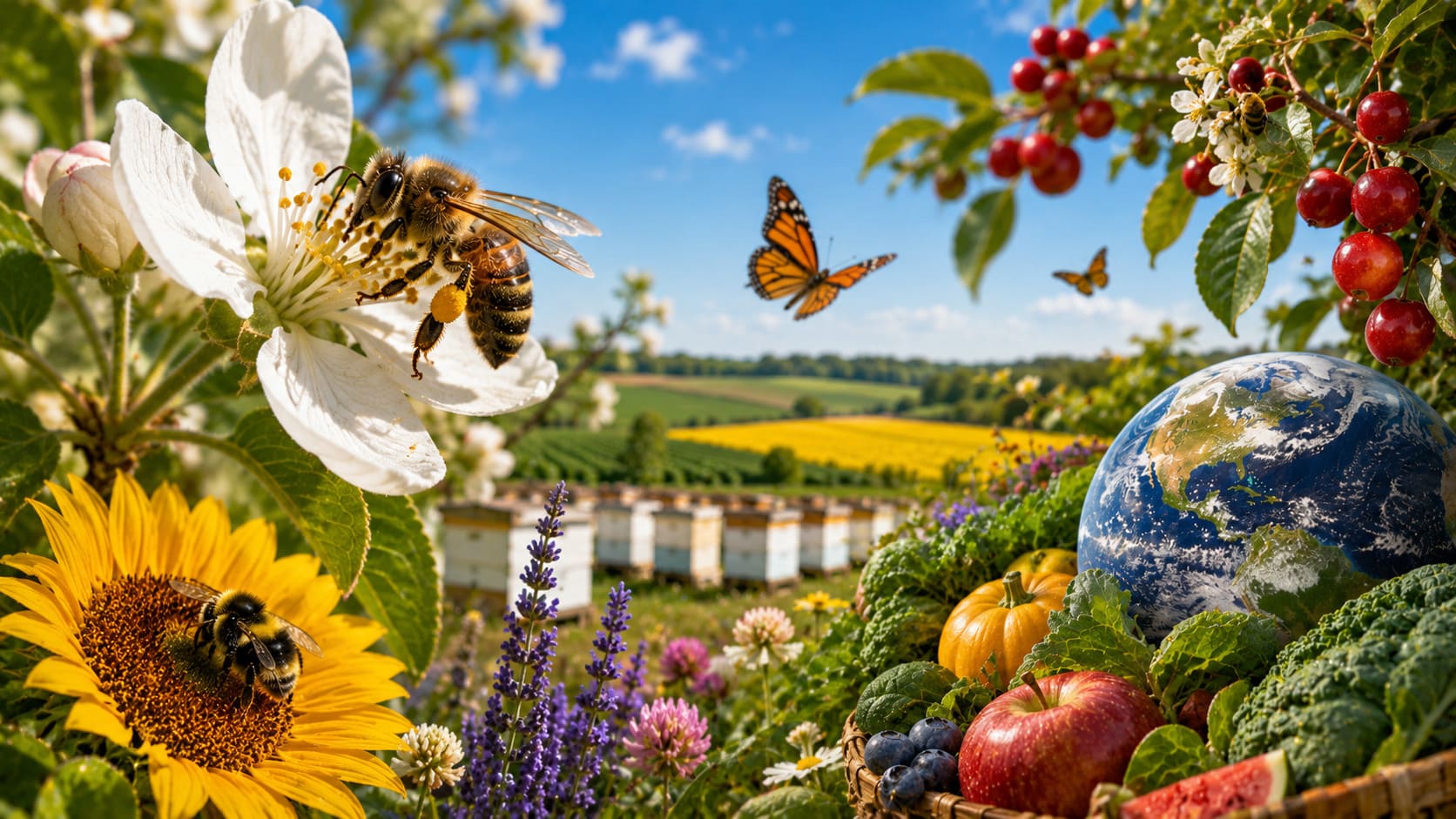
A foraging honey bee transfers pollen between flowers — one of nature’s most important services.
Pollination is the biological process that makes most of the world’s flowering plants — including the majority of our food crops — capable of reproduction. Without it, the diversity of life on Earth as we know it would collapse. Yet many people interact with pollinated food every single day without any awareness of the intricate ecological machinery that makes it possible. This guide, brought to you by Pollination Network, explains what pollination is, how it works, why bees are its most effective agents, and what we can all do to protect this irreplaceable service.
What Is Pollination?
At its most fundamental level, pollination is the transfer of pollen grains from the anther (the male reproductive organ of a flower) to the stigma (the female reproductive organ) of the same or another flower of the same species. When pollen successfully reaches the stigma of a compatible flower, it triggers fertilisation, leading to the development of seeds and fruit.
This deceptively simple description conceals extraordinary complexity. Pollen grains are not passive passengers — they are living cells encased in a remarkably tough outer wall made of sporopollenin, one of the most chemically resistant biological materials known. Each grain carries the genetic blueprint of the male parent, and successful fertilisation requires not just physical transfer but highly specific biochemical recognition between pollen and pistil. Many plants have evolved elaborate mechanisms to prevent self-pollination and promote cross-pollination, which maintains genetic diversity in the population.
Types of Pollination
Self-Pollination
Some plants are capable of pollinating themselves, transferring pollen from the anthers to the stigma of the same flower or to another flower on the same plant. Wheat, barley, rice, tomatoes, and many legumes use this strategy. Self-pollination guarantees reproduction even when pollinators are absent but limits genetic diversity. Tomatoes, though self-fertile, actually benefit significantly from honey bee buzz pollination — a vibrational technique that releases pollen far more efficiently than wind alone.
Cross-Pollination
Cross-pollination — the transfer of pollen between different individual plants of the same species — is the dominant strategy in flowering plants and produces offspring with greater genetic diversity, disease resistance, and vigour. Cross-pollination requires a vector: a physical agent to carry pollen from flower to flower.
Vectors of Pollination
- Biotic pollinators — living organisms including bees, butterflies, moths, beetles, flies, wasps, birds (particularly hummingbirds), and bats. Bees are by far the most effective group, responsible for pollinating approximately 80% of flowering plant species.
- Abiotic pollinators — non-living vectors including wind (anemophily) and water (hydrophily). Wind pollination is common in grasses, conifers, and some deciduous trees. It requires the production of enormous quantities of pollen — explaining seasonal hay fever.
How Honey Bees Pollinate: The Mechanics
The honey bee is such an effective pollinator because of several anatomical and behavioural traits that evolved in concert with flowering plants over tens of millions of years:
Pollen-Collecting Anatomy
Worker honey bees possess specialised structures across their bodies designed to collect and transport pollen. The branched, feather-like hairs covering their thorax and abdomen are electrostatic, creating a charge that attracts pollen grains as the bee moves through a flower. Their hind legs feature the corbiculae — smooth, concave “pollen baskets” bordered by stiff hairs — into which moistened, compacted pollen pellets are loaded for transport back to the hive.
Flower Fidelity
One of the most ecologically significant behaviours of honey bees is flower fidelity or floral constancy — the tendency to visit only one species of flower during a single foraging trip. This focused behaviour ensures that pollen collected from an apple blossom is delivered to another apple blossom, not wasted on an incompatible species. It is this trait, more than any other, that makes honey bees the gold standard pollinator for crop pollination contracts.
The Waggle Dance
When a scout bee discovers a rich nectar source, she returns to the hive and performs the iconic waggle dance on the vertical surface of the comb. The angle of the straight waggle run relative to vertical encodes the direction of the food source relative to the sun; the duration of the waggle run encodes the distance. This sophisticated communication system allows a colony to allocate its foraging workforce efficiently across a landscape, concentrating bees where the nectar reward is highest.
The Scale of Pollination’s Impact
The numbers describing pollination’s economic and ecological importance are staggering. According to estimates published in journals including Ecological Economics and studies by the Food and Agriculture Organisation of the United Nations:
- Animal pollinators contribute to the production of approximately 75% of the world’s food crop types.
- The global economic value of pollination services is estimated at between $235 billion and $577 billion per year.
- Around 35% of global food production volume depends, to some degree, on animal pollinators.
- Crops directly dependent on pollination include almonds (virtually 100% dependent on bees), apples, pears, cherries, blueberries, avocados, cucumbers, courgettes, and most soft fruits.
- Pollination also maintains the biodiversity of wild plant communities, which in turn supports the habitats, food webs, and ecosystem services upon which all terrestrial life depends.
Wild Pollinators vs. Managed Honey Bees
While honey bees receive the most attention, they are one of approximately 20,000 species of bee worldwide. Wild and solitary bees — including bumblebees, mason bees, leafcutter bees, sweat bees, and mining bees — contribute enormously to both agricultural and wild plant pollination. Many are highly efficient pollinators of specific crops: the blue orchard bee (Osmia lignaria) is 80 times more efficient than the honey bee at pollinating stone fruits per individual visit.
The relationship between managed honey bees and wild pollinators is complex. High densities of honey bee colonies can compete with wild bees for floral resources in pollen-limited environments, but they can also benefit wild plants by providing supplementary pollen transfer. The most resilient pollination systems maintain high diversity of both managed and wild pollinators — a principle that underpins much of the work we document at Pollination Network.
Threats to Global Pollination Services
Despite their fundamental importance, pollinator populations worldwide are in documented decline. The drivers are well understood even if the solutions remain challenging to implement at scale:
Habitat Loss
The intensification of agriculture over the past century has removed vast areas of the flower-rich margins, hedgerows, meadows, and woodland edges that pollinators depend on for food and nesting. A single large cereal field blooms briefly or not at all; a diverse mosaic of crops, wildflower strips, and semi-natural habitats provides year-round forage.
Pesticide Exposure
Neonicotinoid insecticides, which are applied systemically and persist in pollen and nectar, have been shown in numerous studies to impair the navigation, learning, and reproductive success of bees at field-realistic concentrations. Several neonicotinoids have been banned or severely restricted in the EU following scientific review.
Disease and Parasites
The Varroa mite, Nosema fungi, and a range of viral pathogens have devastating effects on honey bee colonies. Wild bee populations are also threatened by pathogens that can be transmitted at shared flower resources — a particular concern when honey bee densities are very high in areas with limited forage.
Climate Change
Shifting seasonal phenology — the timing of flowering and the emergence of pollinators — threatens to disrupt the synchrony between plants and their pollinators. If early-blooming plants flower before their specialist pollinators have emerged, both species suffer. Climate change also alters the range and abundance of flower species that form the nutritional basis of pollinator diets.
How You Can Support Pollination
Every gardener, farmer, land manager, and urban planner has a role to play in supporting pollination services. Practical actions include:
- Planting diverse, native flowering plants that bloom from early spring through late autumn.
- Avoiding or replacing neonicotinoid-treated plants in gardens and allotments.
- Maintaining or creating nesting habitat: bare earth patches for mining bees, hollow stems for mason bees, and undisturbed vegetation for bumblebee queens.
- Supporting local beekeeping initiatives and purchasing locally produced honey.
- Advocating for agri-environment schemes that reward farmers for maintaining pollinator habitat.