
Agriculture and Bees: Why Every Farmer Needs to Care About Pollinators
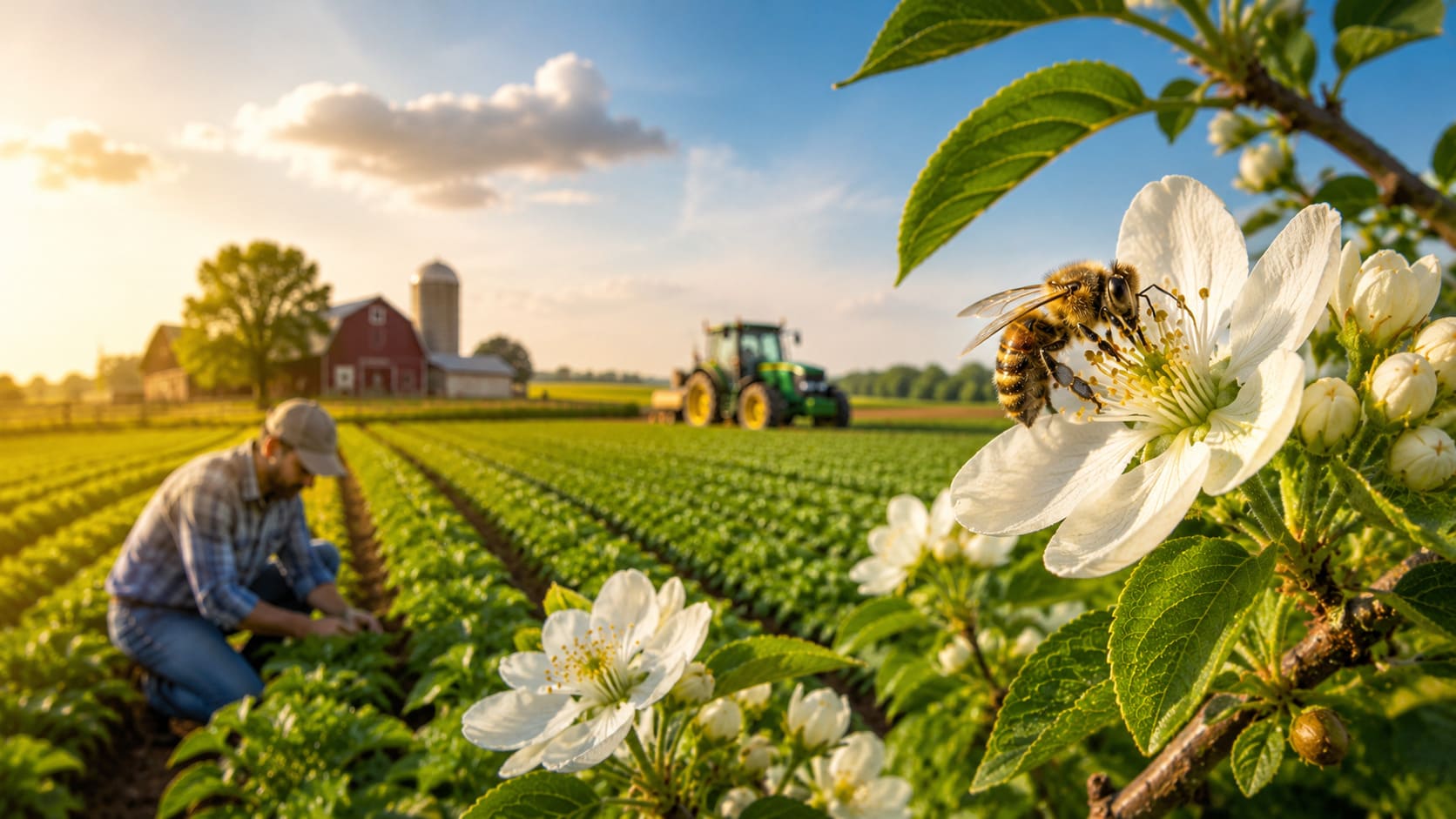
Flowering crops in a diverse agricultural landscape provide essential forage for managed and wild bee populations.
Agriculture and bees share a relationship so deeply interwoven that it is difficult to imagine one without the other. Long before humans began farming, wild bees were already performing the pollination services that shaped the evolution of flowering plants and the ecosystem services those plants provide. When humans transitioned from hunting and gathering to settled agriculture, they unknowingly entered into a partnership with bees that would come to underpin the entire global food supply. At Pollination Network, we explore this vital connection in depth because understanding it is the first step toward protecting it.
The Agricultural Value of Bee Pollination
The direct contribution of bee pollination to global agriculture is almost impossible to overstate. Of the approximately 100 crop species that provide 90% of the world’s food supply, over 70 are pollinated by bees. In the United States alone, managed honey bees contribute an estimated $15 to $20 billion in added crop value per year. In the EU, the pollination service provided by bees is valued at approximately €22 billion annually — roughly 10% of the total value of agricultural production intended for human food.
The crops most dependent on bee pollination span a remarkable range of food categories:
- Tree fruits: apples, pears, cherries, plums, peaches, and almonds
- Soft fruits: strawberries, raspberries, blackberries, blueberries, and cranberries
- Vegetables: courgettes, cucumbers, pumpkins, squash, and melons
- Oilseeds: rapeseed/canola, sunflowers, and coriander
- Legumes: field beans, clover seed, and alfalfa (lucerne)
- Tropical crops: avocados, mangoes, and macadamia nuts
Integrated Pollination Management in Modern Agriculture
The concept of Integrated Pollination Management (IPM) has emerged in recent decades as farmers and agronomists recognise that reliable pollination cannot be taken for granted. IPM treats pollination as a managed input — as deliberate and planned as irrigation, fertilisation, or pest control — rather than a free ecosystem service that nature will always provide.
Assessing Pollination Needs
The first step in IPM is understanding the specific pollination requirements of each crop. Not all crops need the same density of bee visitors, the same type of pollinator, or the same timing of visits. Almonds, for example, require cross-pollination between different almond varieties and are almost entirely dependent on managed honey bee colonies placed in orchards at bloom. Strawberries benefit greatly from bumble bee pollination in addition to honey bee activity, and commercial greenhouse strawberry producers routinely use commercially reared bumble bee colonies for this purpose.
Hive Rental and Pollination Contracts
The commercial crop pollination industry connects farmers needing pollination services with beekeepers who provide them. In this model, beekeepers transport hives to farms during the critical bloom period, often with written contracts specifying the number of hives per hectare, hive strength requirements, placement guidelines, and payment terms. This industry has grown substantially as wild pollinator populations decline and awareness of pollination deficits increases.
On-Farm Habitat Management for Wild Pollinators
Progressive farmers are increasingly recognising that wild pollinators — bumblebees, solitary bees, hoverflies — provide significant supplementary pollination value and are most cost-effective when their populations are supported on the farm itself. Practical habitat management measures include:
- Establishing permanent wildflower margins of 3–6 metres width along field edges
- Creating “beetle banks” — raised, vegetated strips across large arable fields
- Reducing or eliminating tillage of hedgerow and ditch banks used by solitary ground-nesting bees
- Sowing pollen and nectar seed mixes in set-aside areas under agri-environment schemes
- Maintaining diverse crop rotations that include flowering legumes such as clover and beans
The Pesticide Dilemma in Agriculture
One of the most contentious and consequential issues at the intersection of agriculture and bee conservation is the use of pesticides. Modern intensive agriculture relies heavily on synthetic pesticides to protect crop yields, but many of these products are toxic to bees and other pollinators to varying degrees.
Neonicotinoids: Science and Policy
Neonicotinoids are a class of systemic insecticides that are absorbed by the plant and expressed in pollen and nectar. They are neurotoxic to insects, targeting the same nicotinic acetylcholine receptors that organophosphates and carbamates affect, but with much greater selectivity for insect nervous systems compared to mammalian ones. Laboratory and field studies have demonstrated that sub-lethal neonicotinoid exposure impairs bee navigation, learning and memory, foraging efficiency, queen production, and colony growth. The EU enacted a near-total ban on outdoor neonicotinoid use for agricultural crops in 2018; the UK and several other countries have followed with partial restrictions.
Integrated Pest Management and Bee Safety
Responsible farmers can dramatically reduce their impact on bees through integrated pest management practices that prioritise biological controls, resistant varieties, cultural methods, and targeted pesticide applications that avoid the flowering period. When insecticide application is unavoidable during bloom, choosing products with lower bee toxicity, applying at dawn or dusk when bees are not foraging, and communicating with local beekeepers to allow temporary hive movement are all best-practice measures.
Agricultural Systems That Benefit Bees
Not all agricultural systems are equally harmful to pollinators. Several production systems have emerged that demonstrate how farming can be both economically productive and ecologically supportive of bee populations:
Organic Farming
Certified organic systems prohibit synthetic pesticide use and typically require diverse crop rotations, the maintenance of natural habitat features, and the avoidance of genetically modified organisms. Studies consistently find higher bee abundance and diversity on organic farms compared to conventionally managed equivalents, though the relative contribution of pesticide avoidance versus other factors continues to be debated.
Agro-Ecological Farming
Agro-ecology goes beyond organic certification to explicitly integrate ecological principles into farm design. Polycultures, agroforestry, cover cropping, and on-farm biodiversity are all central principles. These approaches often generate complex, flower-rich landscapes that support diverse pollinator communities throughout the season — not just during the main crop bloom.
Regenerative Agriculture
The rapidly growing regenerative agriculture movement places soil health at the centre of farm management. Cover crops, reduced tillage, and the avoidance of bare soil not only build soil organic matter but create nesting habitat for ground-dwelling solitary bees and support the root-zone fungi (mycorrhizae) that many flowering plants depend on. The pollination benefits of regenerative systems are just beginning to be quantified.
Policy Frameworks Supporting Agricultural Pollination
Government policy plays a critical role in shaping the agricultural landscape that pollinators inhabit. Key mechanisms include:
- Agri-environment schemes: payments to farmers for maintaining ecologically valuable habitats including wildflower meadows, unimproved grasslands, and field margins.
- Pesticide regulation: science-based assessment and approval of pesticide products, with explicit consideration of pollinator risk, and mandatory post-authorisation monitoring.
- National pollinator strategies: coordinated action plans adopted by the UK, EU member states, and many other countries to reverse pollinator decline.
- Public procurement and food labelling: using public purchasing power and consumer information to reward pollinator-friendly production systems.
To learn more about how individual beekeepers contribute to agricultural pollination at a practical level, read our guide on crop pollination services. To understand the biology of the bees performing this work, visit our honey bee facts page.