
Varroa Mite and Bee Disease Management: Protecting Your Colony
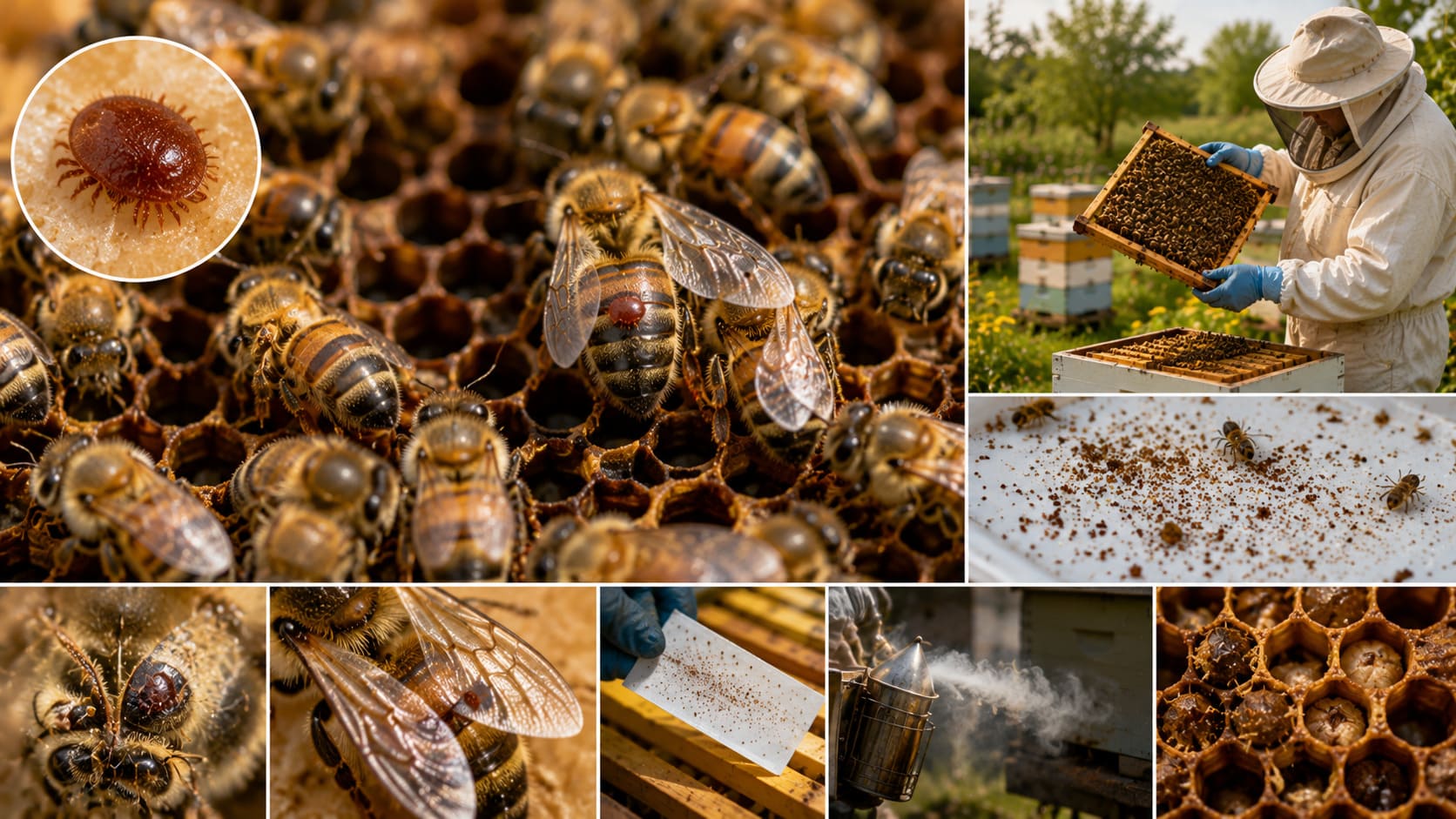
Regular hive inspection and accurate mite monitoring are the foundation of effective Varroa management in modern beekeeping.
Of all the challenges facing today’s beekeeper, Varroa mite management stands above all others as the critical determinant of colony survival. Since the global spread of Varroa destructor through managed and feral honey bee populations in the second half of the 20th century, beekeeping has been permanently transformed. Colonies that are not actively managed for Varroa will collapse within two to five years. Understanding the biology of this parasite, the range of management tools available, and the principles of integrated mite management is therefore not optional knowledge for the modern beekeeper — it is fundamental. This guide from Pollination Network provides a comprehensive overview of Varroa and the full range of bee diseases that threaten colony health.
Understanding Varroa destructor
Biology and Life Cycle
Varroa destructor is a red-brown, oval external parasitic mite of approximately 1.1 mm x 1.6 mm — barely visible to the naked eye on dark bees, but detectable with attention during hive inspections. Its natural host is the Asian honey bee Apis cerana, with which it co-evolved over millions of years. Apis cerana has behavioural and physiological resistance mechanisms — including uncapping and removing infested pupae and grooming mites from nestmates — that keep Varroa populations in check. Apis mellifera, exposed to this parasite only since the mid-20th century, lacks these co-evolved defences.
The Varroa life cycle exploits the sealed brood stage of the bee development cycle:
- A phoretic (hitchhiking) adult female mite enters a brood cell containing a late-stage larva, just before capping.
- Once the cell is sealed, she lays her first egg — an unfertilised egg that develops into a male — followed by 1–5 fertilised eggs that develop into females.
- The developing mites feed on the developing bee pupa’s haemolymph (bee “blood”), causing direct physical damage and transmitting viruses.
- When the adult bee emerges, the mated daughter mites emerge with it and resume phoretic existence on adult bees, seeking new brood cells to repeat the cycle.
- Only the foundress mite and the last-laid daughter mite typically survive to successfully complete mating within the cell.
The mite strongly prefers drone brood, which has a longer sealed period — allowing more daughter mites to mature — and represents a significant amplification site for mite populations.
Why Varroa Is Deadly
Varroa kills colonies through multiple synergistic mechanisms. The direct physiological damage caused by feeding on pupae produces bees with deformed wings, shortened abdomens, reduced learning and memory capacity, and weakened immune systems. Far more significantly, Varroa transmits a suite of viral pathogens — Deformed Wing Virus (DWV) being the most devastating — that circulate at low titres in healthy colonies but explode to lethal levels as Varroa populations grow. A colony with a high Varroa burden in autumn will attempt to winter with a cohort of short-lived, virally compromised bees that cannot sustain the winter cluster, resulting in colony collapse.
Monitoring Varroa: The Foundation of Management
Effective Varroa management begins with accurate monitoring. Treatment decisions should be based on actual mite counts, not calendar dates or assumptions. The three main monitoring methods are:
Alcohol Wash
A sample of 300 worker bees is washed in alcohol, which detaches all mites from the bees. The washed bees and mites are counted separately, giving a precise percentage mite infestation rate. This is considered the gold standard monitoring method for accuracy. A rate above 2–3% during the active season typically triggers a treatment decision.
Sugar Roll
Similar to alcohol wash but using powdered sugar rather than alcohol, allowing sampled bees to be returned to the hive. Slightly less accurate than alcohol wash but preferred by beekeepers who wish to avoid killing bees in the sample.
Sticky Board (Natural Mite Fall)
A sticky board placed on the hive floor catches mites that naturally fall from bees over a 24-72 hour period, providing an indirect measure of colony mite burden. Less accurate than the above methods for a snapshot assessment, but useful for monitoring population trends over time.
Varroa Treatment Options
Organic Acids
Organic acids — primarily oxalic acid and formic acid — are the most widely used treatments in sustainable beekeeping programmes worldwide:
- Oxalic acid: highly effective against phoretic mites (those on adult bees) but ineffective against mites inside sealed brood. Most effective when applied during broodless periods (winter cluster or artificially created broodless conditions). Available as a dribble solution, sublimation (vaporisation), or extended-release organic strips. Very low bee toxicity at correct doses.
- Formic acid: volatile acid that penetrates sealed brood cells, making it effective against reproductive mites as well as phoretic mites — the principal organic treatment that kills mites in capped brood. Requires careful temperature management during application (most effective between 10°C and 29°C). Can cause temporary queen loss and brood damage if applied incorrectly.
Thymol-Based Products
Thymol, the active compound in thyme essential oil, is effective against phoretic Varroa at warm temperatures (above 15°C). Commercial products (Apiguard, ApiLifeVar, Thymovar) are approved in most European countries and have a long safety record. Not suitable for treatment when supers containing honey for human consumption are on the hive.
Synthetic Acaricides
Amitraz-based strips (Apivar) and flumethrin/coumaphos strips (Bayvarol, Apistan, CheckMite+) are synthetic acaricides that provide highly effective mite control but carry risks of residue accumulation in beeswax and the development of mite resistance with repeated use. Rotation of treatment chemistries is essential to prevent resistance build-up.
Biotechnical Methods
Biotechnical methods exploit Varroa’s biology to reduce mite populations without chemical inputs:
- Drone brood removal: inserting drone-sized foundation into the colony, allowing mites to preferentially infest the drone brood, then removing and destroying the capped drone comb before mites complete development. Can reduce mite build-up by 30–40% but requires consistent application and does not eliminate the need for chemical treatment.
- Brood break / artificial swarm: removing the laying queen from the colony (or creating a split) to create a period without capped brood, during which an oxalic acid treatment achieves near-100% efficacy against phoretic mites.
Beyond Varroa: Other Significant Bee Diseases
American Foulbrood (AFB)
Caused by Paenibacillus larvae, AFB is the most serious bacterial brood disease. Infected larvae turn brown and liquefy into a sticky, ropy mass with the characteristic smell of rotting fish. The diagnostic test is inserting a matchstick into the liquefied larvae and withdrawing it — if it pulls out a “string” of greater than 10 mm, AFB is suspected. Spores are extraordinarily persistent in wood and wax. Most countries require mandatory reporting and prescribe destruction of infected equipment. There is currently no licensed antibiotic treatment permitted in the EU or UK.
European Foulbrood (EFB)
Caused by Melissococcus plutonius, EFB is a stress-related bacterial disease that kills larvae before capping, leaving them discoloured and twisted in an unnatural position in the cell. Unlike AFB, EFB spores are less persistent and the disease often resolves with improved nutrition and colony management. Treatment with oxytetracycline is licensed in some jurisdictions.
Nosema
Nosema species (Nosema apis and the more virulent Nosema ceranae) are microsporidian fungi that infect the midgut epithelium of adult bees, disrupting digestion and energy metabolism. Severe nosema infection causes rapid bee depopulation and poor spring build-up. Diagnosis requires microscopy of macerated bee abdomens. Management includes good nutrition, avoiding damp overwintering conditions, and the use of fumagillin (where licensed).
Sacbrood Virus
Sacbrood is caused by a picornavirus and is one of the most common brood diseases. Infected larvae fail to pupate, turning yellow then brown and forming a characteristic fluid-filled sac inside their skin. Most colonies manage low-level sacbrood infections without significant impact; heavy infections typically resolve spontaneously, particularly with the introduction of a new queen.
Chalk Brood and Stone Brood
Chalk brood (Ascosphaera apis) and stone brood (Aspergillus spp.) are fungal diseases that mummify bee larvae. Chalk brood is common, usually self-limiting, and associated with damp, poorly ventilated hive conditions and nutritional stress. Stone brood is rare but more serious, producing rock-hard mummified larvae and being potentially toxic to bees and handlers.
Biosecurity in the Apiary
Good biosecurity practices are the first line of defence against all bee diseases:
- Never introduce used equipment from unknown sources without thorough sterilisation.
- Register all apiaries with the national bee disease monitoring scheme (mandatory in many countries).
- Request inspection from your national or regional Bee Inspector if you suspect a notifiable disease.
- Maintain a hive diary recording all observations, treatments, and queen events — essential for tracking disease history and treatment responses.
- Source replacement bees and queens from reputable, disease-tested sources.
Healthy bees are the foundation of effective crop pollination and sustainable honey production. Investing time in disease literacy is one of the highest-return activities available to any beekeeper at any level of experience. Visit our agriculture and bees guide to understand how colony health connects to the broader food system.