
Pollinator Conservation and the Future of Bees: What Science Tells Us and What We Must Do
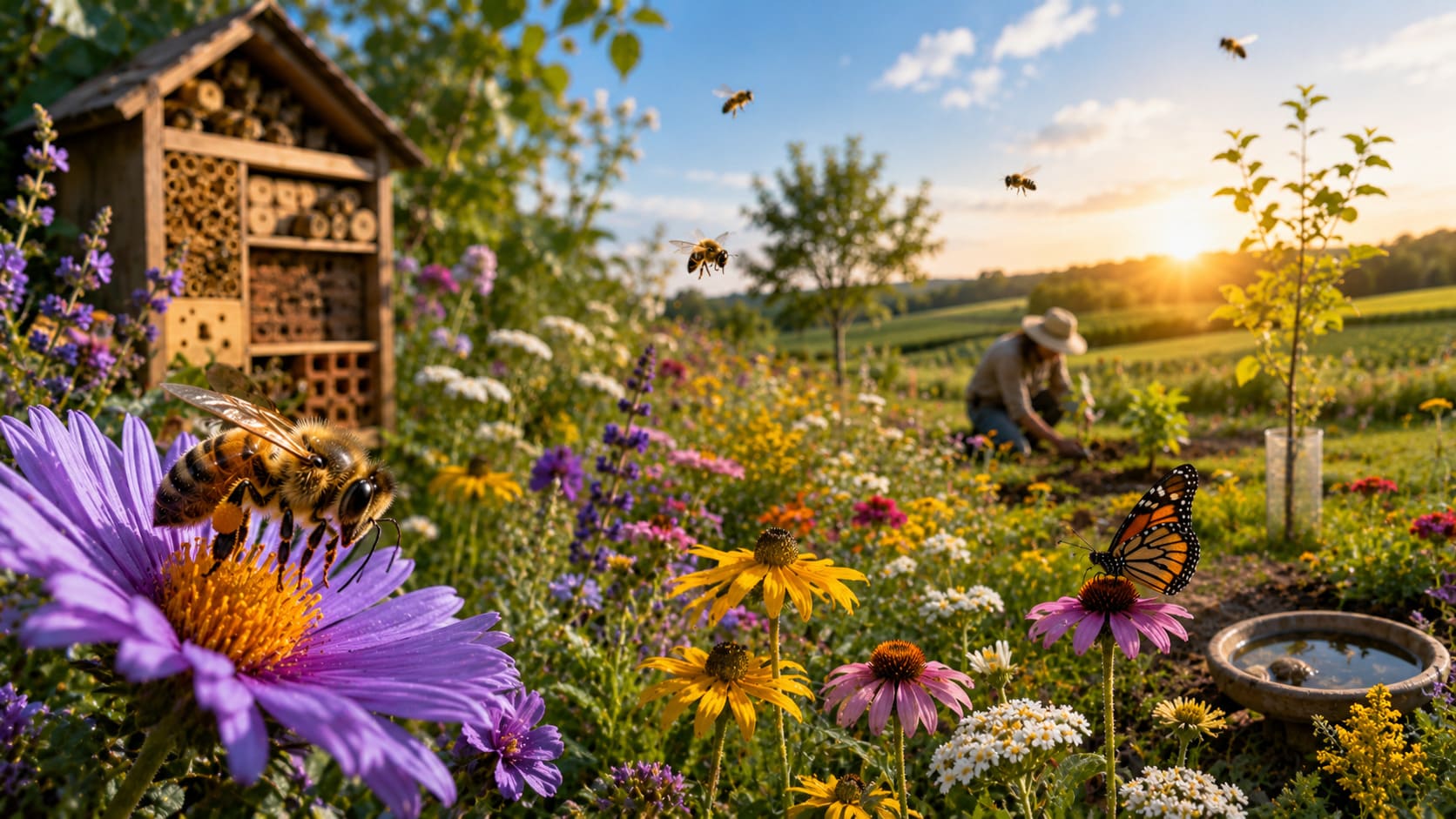
A bumblebee foraging in a restored wildflower meadow — the kind of habitat that can reverse pollinator decline when created at landscape scale.
We stand at a critical juncture in the relationship between human civilisation and the pollinators upon which so much of our food system, cultural landscape, and ecological wealth depends. The evidence for widespread pollinator decline is now unambiguous; the consequences for agriculture, wild plant communities, and ultimately human wellbeing are serious and well-documented. Yet this is not a story without hope. Decades of research, conservation practice, and increasingly supportive policy are beginning to show what recovery looks like — and the role that individuals, communities, farmers, and governments can all play in achieving it. Pollination Network is dedicated to accelerating this recovery by connecting knowledge with action.
The State of Global Pollinator Populations: What Science Knows
The scientific literature on pollinator population trends has grown dramatically in the past two decades, producing a clearer if sobering picture of the global situation:
Honey Bees
Managed honey bee colony numbers have declined by approximately 25% in North America and parts of Europe since the 1960s, with dramatic losses in some years attributable to Colony Collapse Disorder (first reported in 2006). The US lost an estimated 30–45% of managed colonies annually in the late 2000s, though the industry has largely adapted through more intensive management and replacement colony production. The fundamental problems — Varroa, pesticide exposure, habitat loss, and pathogen pressure — have not been solved; they have been managed at significant economic cost to beekeepers and farmers alike.
Wild Bees
The situation for wild bee populations is considerably more concerning than the managed honey bee story, partly because wild bees cannot be readily replaced or managed in the same way. A landmark study published in Science in 2016 found that wild bee abundance in the United States had declined in 23% of land area assessed between 2008 and 2013, with the sharpest declines in the Midwest corn belt, Mississippi floodplain, and California’s Central Valley — the agricultural heartlands of the country. European datasets tell a similar story: surveys of bumblebee ranges have documented dramatic contractions, with several species now nationally extinct or critically endangered in countries where they were historically widespread.
Other Pollinators
Decline is not limited to bees. Monarch butterfly populations in North America have declined by approximately 80% over three decades. Many hoverfly species — effective pollinators of numerous crop and wild plant species — have shown significant range contractions. Moth populations in Britain have declined by 30% since the 1970s. This broad insect decline is consistent with the Integrated Landscape Hypothesis: the cumulative effects of multiple stressors interacting synergistically in an increasingly simplified and chemically intensive agricultural landscape.
The Interconnected Drivers of Decline
No single cause explains pollinator decline; the scientific consensus points to the synergistic interaction of multiple drivers:
Habitat Loss and Degradation
The conversion of flower-rich habitats to intensive agricultural use, built development, and “tidied” urban spaces is universally recognised as the primary driver. The loss of the ecological infrastructure — hedgerows, woodland edges, unimproved grasslands, marshes, heath — that sustained diverse pollinator communities across centuries of lower-intensity land management is the foundational problem from which all others are amplified.
Pesticide Exposure
The landscape-scale application of systemic insecticides, fungicides (which impair bee immunity and interact synergistically with insecticides), and herbicides (which reduce floral diversity by eliminating “weed” species that are important pollinator forage) creates a chemical environment that is chronically stressful for pollinator health, even when individual exposures are below legally defined thresholds for lethal effects.
Parasites and Pathogens
The global movement of managed bees for crop pollination and the honey trade has facilitated the worldwide spread of parasites (Varroa, Aethina tumida — the small hive beetle) and pathogens (Nosema ceranae, Lotmaria passim — an intestinal parasite) that have had catastrophic effects on both managed and wild bee populations with no prior exposure and co-evolved resistance.
Climate Change
Climate change is operating simultaneously as a direct stressor (extreme weather events, changing seasonal temperatures) and as an amplifier of existing vulnerabilities. Phenological mismatches — bees emerging before their key forage plants bloom, or vice versa — threaten specialist relationships that have persisted for thousands of years. Range shifts are pushing some species northward while contracting the cool upland habitats that specialist montane species require.
Evidence-Based Solutions: What Actually Works
The good news is that we have a growing body of evidence on effective interventions — and the tools exist to reverse pollinator decline if deployed at sufficient scale. Key findings from the scientific literature include:
Habitat Restoration
Agri-environment schemes that fund the creation and management of flower-rich habitats on farmland demonstrably increase pollinator abundance and diversity. A major study of Higher Level Stewardship agreements in England found that farms with well-managed flower margins had significantly higher bumblebee species richness and abundance than equivalent control farms. The critical factors are floral diversity, spatial continuity across the landscape (not just isolated patches), and quality of management (cutting regime, avoidance of fertiliser applications).
Pesticide Policy Reform
The EU’s 2018 restrictions on outdoor use of three major neonicotinoids were followed, in subsequent monitoring, by measurable improvements in wild bee populations in some monitored landscapes — though the evidence for attribution is necessarily complex. The precautionary principle, applied consistently to all new pesticide chemistries, combined with post-authorisation monitoring of pollinators, represents the most defensible regulatory approach.
Varroa-Resistant Bee Breeding
The breeding of honey bee stocks with genetically heritable Varroa resistance — through selection for hygienic behaviour, suppressed mite reproduction, and grooming behaviour — is one of the most promising medium-term solutions to the Varroa crisis. Programmes including the VSH (Varroa Sensitive Hygiene) line in the US, the BLUP breeding programme in Germany, and natural selection-based conservation programmes in Gotland (Sweden) and the Isle of Wight (UK) have demonstrated that co-evolutionary adaptation is possible with systematic breeding support. Resistant stocks that allow sustainable, reduced-chemical beekeeping would transform the economics and ecology of both beekeeping and crop pollination services.
Landscape-Scale Connectivity
Individual habitat patches — however well managed — have limited effectiveness if they are isolated in a matrix of hostile landscape. Research on bumblebee populations has demonstrated that landscape connectivity, measured as the density of semi-natural habitat within foraging range of focal patches, is as important as local habitat quality in determining population persistence. This means that effective conservation requires coordinated action across farm boundaries, coordinated under catchment-scale or regional-scale agri-environment frameworks.
The Role of Citizens and Communities
While the structural drivers of pollinator decline require policy-level responses, individual and community action collectively represents an enormous force for change. The evidence on domestic garden planting, for example, shows that gardens cover approximately 270,000 hectares in the UK — an area larger than the entire national network of nature reserves. If managed with pollinators in mind, this represents a transformational habitat network.
Citizen science initiatives — from the Bumblebee Conservation Trust’s BeeWalk to the University of Sussex’s Great British Bee Count and iNaturalist globally — have built species distribution datasets that underpin national conservation assessments and research. Every observation submitted by a citizen scientist is a genuine contribution to the knowledge base that informs government policy.
Supporting local beekeepers, advocating for pollinator-friendly public land management, choosing organic or regeneratively produced food, and participating in community habitat restoration projects are all actions with real, measurable ecological impact. Explore our guides on wildflower planting, agriculture and bees, and the science of pollination to translate that commitment into practical action.
The Future: Technology, Policy, and Ecological Restoration
The future trajectory of pollinator conservation will be shaped by the interaction of technological innovation, policy frameworks, and the continuing evolution of our scientific understanding:
Precision Conservation
Remote sensing, machine learning-based landscape analysis, and eDNA (environmental DNA) monitoring are creating unprecedented capacity to map pollinator habitats, identify priority restoration sites, and track population recovery at landscape scale. These tools are beginning to move from research settings to practical conservation management.
Genomic Tools
Whole-genome sequencing of wild bee populations is revealing the genetic architecture of local adaptation, the population connectivity of different species across fragmented landscapes, and the genetic basis of disease resistance and pesticide detoxification — knowledge that will underpin more targeted, effective conservation interventions.
Policy Innovation
Post-Brexit agricultural policy in England — particularly the Environmental Land Management Scheme, which pays farmers for ecosystem services including pollinator support — represents a significant departure from area-based subsidy payments. If adequately funded and well designed, such schemes have transformational potential. The EU’s Farm to Fork strategy and its 2030 biodiversity targets similarly set an ambitious framework for pollinator-friendly agricultural transition, though the gap between stated ambition and on-farm implementation remains substantial.
Rewilding and Natural Recovery
The rewilding movement — allowing natural processes to restore ecological complexity with minimal intervention — is demonstrating at projects like Knepp Estate in West Sussex that dramatic recoveries of pollinator diversity are achievable within years when the conditions of extensive grazing and reduced management intensity are established. Rewilding is not a universal solution but represents a powerful tool at appropriate scales.
Our Collective Responsibility
The story of pollinator decline is ultimately a story about the choices embedded in our food systems, our land management practices, and our relationship with the natural world. It is a story in which every actor — from individual consumer to multinational food company, from urban gardener to national government — has both a role and a responsibility. The science is clear about what is happening and what needs to change. Whether we choose to act at the scale and speed the evidence demands is a question of values as much as knowledge.
At Pollination Network, we believe that connecting people with the best available knowledge is the most powerful thing we can do to accelerate the transition to a world where pollinators, the plants they serve, and the food systems they support can all flourish. We invite you to explore our guides, engage with the science, and take whatever actions — large and small — are within your reach.