
Honey Production and Processing: From Hive to Jar
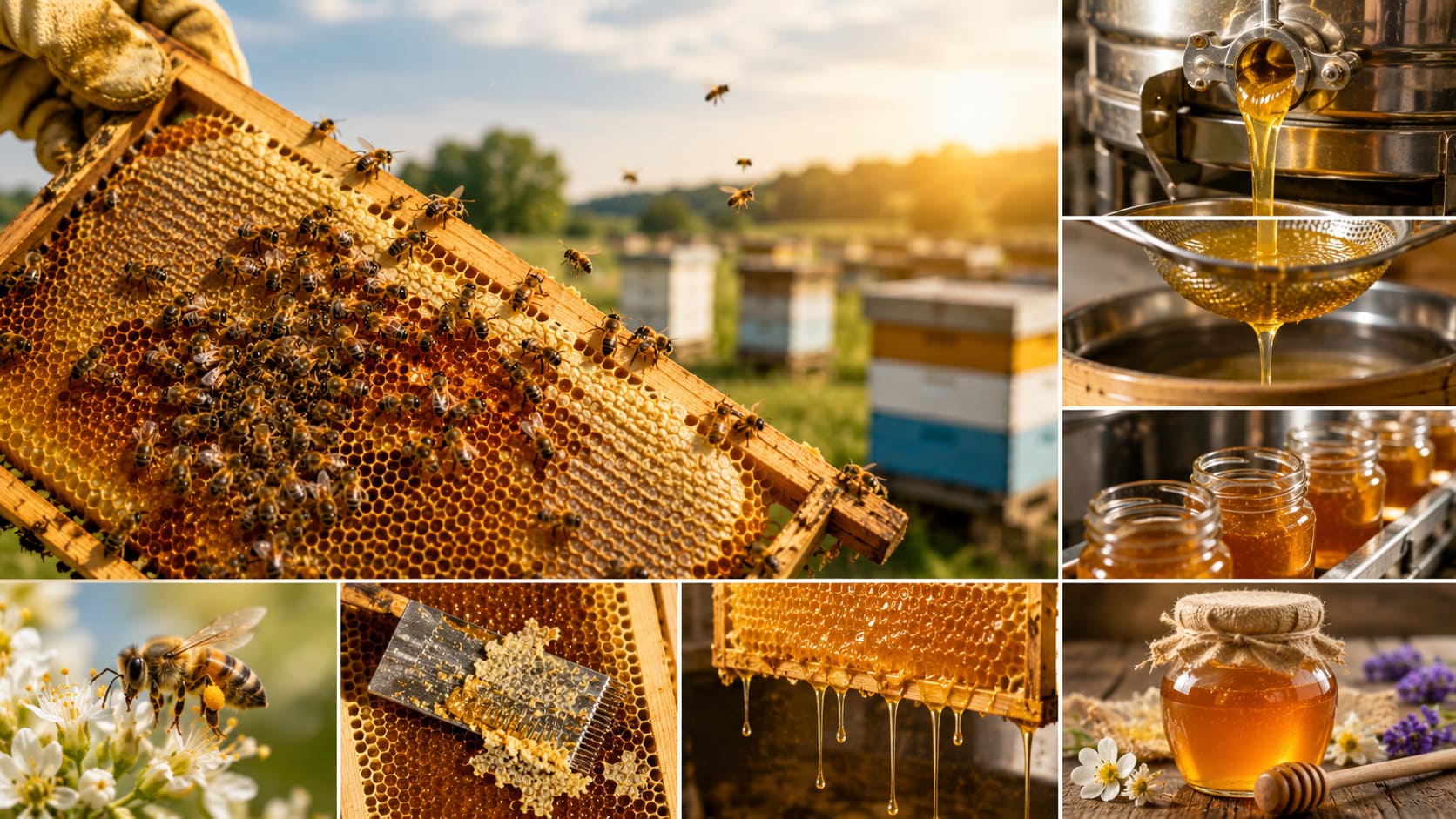
Fresh honey flowing from a centrifugal extractor — the result of thousands of bee-hours and millions of flower visits in the surrounding landscape.
Honey is one of the world’s most ancient and complex foods — a substance that has been harvested from wild bee nests for at least 8,000 years, stored in Egyptian tombs for millennia without spoiling, celebrated in the poetry of Virgil, and traded across continents as a luxury commodity. Yet for all its cultural weight, the process of transforming it from the raw nectar gathered by foraging bees into the clear, fragrant, shelf-stable product that reaches the consumer is a fascinating combination of insect biochemistry, beekeeper craft, and food science. This guide from Pollination Network takes you through every stage of honey production and processing — from the foraging biology of honey bees to the regulations governing honey labelling.
The Nectar: Raw Material of Honey
Honey begins its existence as nectar — a dilute aqueous solution produced in the nectaries of flowering plants as an evolutionary incentive for pollinators to visit. Nectar composition varies enormously by plant species but typically comprises 20–80% sugars (primarily sucrose, fructose, and glucose), water, amino acids, organic acids, vitamins, phenolic compounds, and minute quantities of secondary metabolites that will ultimately contribute to the characteristic flavour of the resulting honey.
The sugar concentration of nectar when collected by bees is typically 15–75% (Brix). Honey, by contrast, must contain less than 18–20% water to be stable against fermentation by wild yeasts. The production of honey is therefore primarily a dehydration process — converting a dilute sugar solution into a stable, supersaturated one through the combined action of bee biochemistry and colony thermoregulation.
The geographic source of nectar defines the “terroir” of honey — its flavour, colour, aroma, and chemical composition. This reflects the same pollination landscape in which the bees operate. Understanding the local floral calendar is therefore as important to the honey producer as it is to the agronomist or conservationist.
Honey Flow: When to Add Supers
The “honey flow” — the period when nectar is available in large quantities from major forage species in the area — is the key production window for the beekeeper. Timing varies enormously by geographic location and annual weather conditions. In the UK, the main honey flows typically occur in May–June (fruit trees, dandelion, hawthorn), June–July (white clover, bramble, lime/linden), and August–September in heathland areas with heather.
The beekeeper’s task at the start of a honey flow is to ensure the colony has:
- Adequate space in honey supers to receive and process incoming nectar without becoming honey-bound (filling brood space with honey, restricting the queen’s laying space).
- A strong forager population — the culmination of the spring build-up managed by the beekeeper from the previous autumn.
- A queen excluder separating the brood boxes from the honey supers, preventing the queen from laying eggs in honey storage areas.
Knowing When to Harvest: Cappings and Water Content
The single most important quality criterion in honey production is water content. Honey with a water content above 20% will ferment — yeasts present in all honey will multiply and convert sugars to alcohol and CO₂, producing a product that is no longer legally marketable as honey in most jurisdictions. The beekeeper’s primary tool for assessing harvest readiness is visual inspection of capping: when bees have capped 80–90% or more of a super’s cells with beeswax, the honey within is generally adequately dry. A refractometer — an optical instrument that measures the refractive index of a honey sample — provides the definitive water content measurement and should be a standard tool in every honey producer’s kit.
Honey Extraction: Equipment and Process
Uncapping
Before extraction, the thin wax cappings must be removed from the surface of the filled combs. This is done with an uncapping knife (heated electrically or by immersion in hot water), an uncapping fork, or an automated uncapping machine in larger operations. The wax cappings represent a premium beeswax product and are collected for rendering, filtering, and sale.
Centrifugal Extraction
The great majority of modern honey production uses centrifugal extraction. Uncapped frames are loaded into a radial or tangential extractor — essentially a stainless steel drum with an internal basket that spins the frames, throwing honey from the cells by centrifugal force. Radial extractors (frames mounted like spokes of a wheel) extract both sides simultaneously; tangential extractors require manual rotation of frames between extraction runs. Honey flows down the extractor walls and drains through a gate in the base.
Straining and Settling
Extracted honey passes through stainless steel strainers or food-grade nylon cloths to remove wax particles, propolis, and bee fragments. It then settles in food-grade settling tanks — typically for 24–72 hours at room temperature — during which air bubbles, foam, and fine particles rise to the surface, producing the clear, bubble-free product preferred by most consumers.
Creamed (Set) Honey
Many honey varieties crystallise naturally. Crystallisation is a normal physical process — the precipitation of glucose monohydrate crystals from the supersaturated sugar solution — and does not indicate fermentation or spoilage. Creamed honey is produced by “seeding” liquid honey with a small proportion (5–10%) of finely crystallised set honey, then holding it at 14°C. This produces a uniformly fine-grained, spreadable product preferred by many consumers over coarse or irregular crystallisation.
Honey Varieties: A World of Flavour
The diversity of honey available to the knowledgeable consumer reflects the extraordinary diversity of the world’s flowering plant species and the geographic landscapes in which bees forage:
- Acacia (black locust) honey: pale, water-clear, very slow to crystallise; mild, clean sweetness; the most widely traded varietal honey in Europe.
- Manuka honey (Leptospermum scoparium, New Zealand): dark, strongly flavoured; high methylglyoxal (MGO) content associated with antimicrobial activity; commanding premium prices in health food markets.
- Heather (ling) honey: amber-coloured; distinctive thixotropic (gel-like) texture caused by high protein content; intense, complex flavour; must be extracted by pressing rather than centrifugal methods.
- Linden (lime blossom) honey: pale gold; strongly aromatic, with notes of mentholated freshness and fresh grass; prized in Central and Eastern European markets.
- Chestnut honey: dark amber; intensely aromatic; bitter finish; very high fructose content, slow to crystallise; typical of forested regions of France, Italy, and the Balkans.
- Wildflower (polyfloral) honey: the most widely produced type; flavour profile reflects the specific local forage landscape; enormous variety from region to region and year to year.
Honey Quality, Standards, and Legislation
In most developed markets, honey production and labelling is governed by legally enforceable quality standards. In the EU, the Honey Directive (2001/110/EC and subsequent amendments) specifies minimum quality requirements including maximum water content (≤20%, or ≤23% for heather honey), minimum total sugar content, maximum diastase activity decline, maximum hydroxymethylfurfural (HMF) content (an indicator of overheating or ageing), and requirements for country of origin labelling. UK honey regulations post-Brexit have retained broadly equivalent standards.
Adulteration of honey — dilution with sugar syrups, mislabelling of geographic origin, or false varietal claims — is a significant and well-documented problem in the global honey market. Laboratory techniques including nuclear magnetic resonance (NMR) spectroscopy, isotope ratio analysis, and pollen analysis (melissopalynology) are used by food authorities and researchers to authenticate honey origin and detect adulteration. Supporting genuine local producers and purchasing directly from registered beekeepers is the most reliable way for consumers to ensure honey authenticity.
The Health Properties of Honey
Honey has been used medicinally across cultures for thousands of years, and modern food science is confirming many of the traditional claims — while providing important context about proportionality and evidence quality:
- Antimicrobial properties: honey’s low water activity, acidic pH, and hydrogen peroxide content (produced by the enzyme glucose oxidase) inhibit the growth of bacteria and yeasts. Medical-grade Manuka and Buckwheat honeys are used in wound management, with evidence supporting efficacy for certain wound types.
- Antioxidant content: darker honeys — buckwheat, chestnut, propolis-rich polyfloral — have significantly higher antioxidant content than light-coloured varietals, reflecting a higher concentration of phenolic compounds from their floral sources.
- Prebiotic potential: oligosaccharides in honey may support beneficial gut bacteria, though evidence is preliminary.
- Cough and respiratory health: several randomised controlled trials have found honey equivalent to or more effective than over-the-counter cough suppressants for acute cough in children. This has led several national health services to recommend honey as a first-line management option for childhood cough.
Honey should not be given to infants under twelve months of age due to the risk of infant botulism from Clostridium botulinum spores, which the infant gut cannot resist.