
Honey Bee Facts: The Extraordinary Biology of Apis mellifera
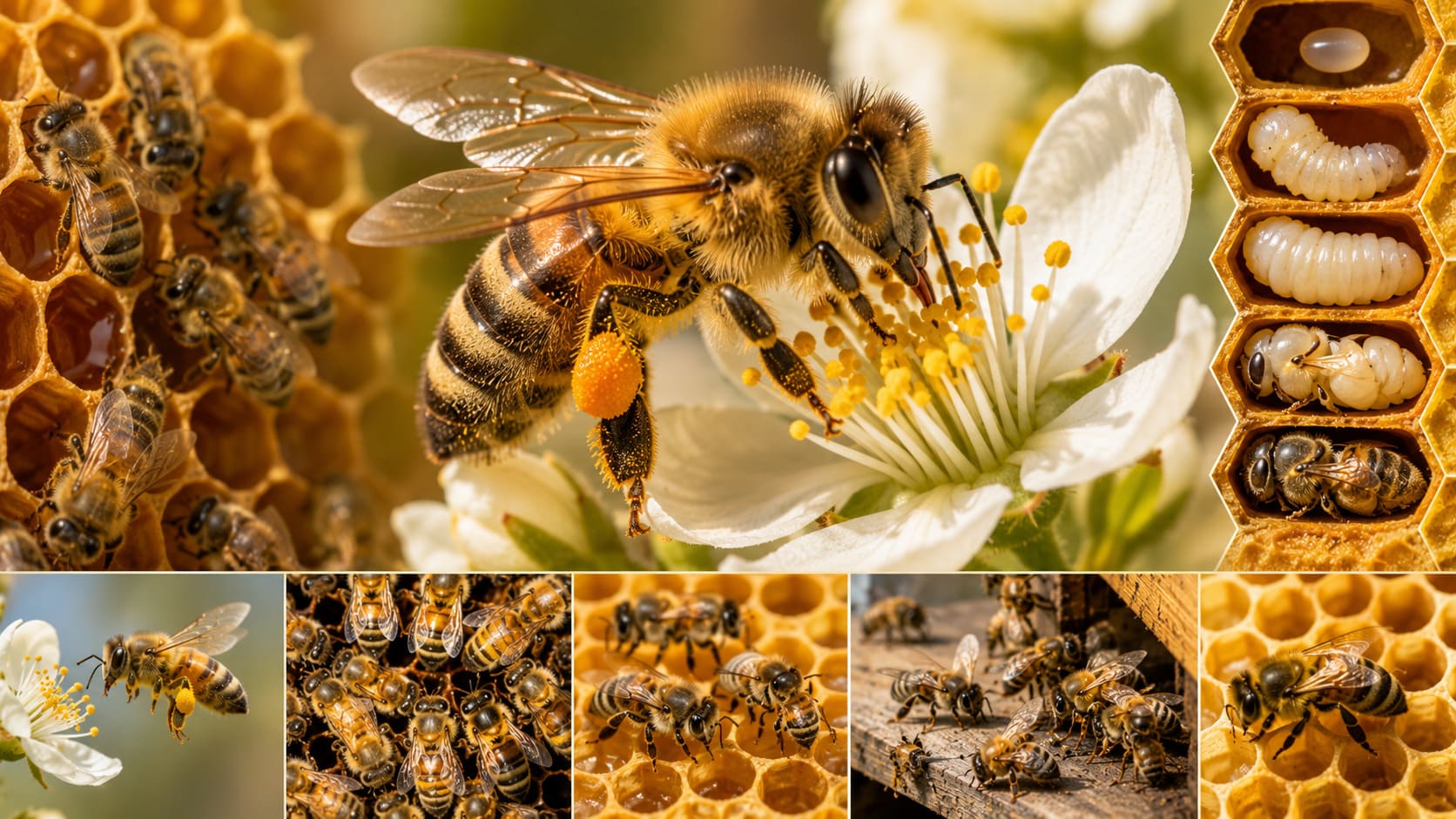
Worker honey bees tend capped honeycomb cells — the result of thousands of foraging flights and complex chemical processing.
Few creatures on Earth have shaped human civilisation, culture, agriculture, and ecosystems as profoundly as the western honey bee, Apis mellifera. Yet despite our 9,000-year relationship with this species, the depth of its biology remains surprising even to experienced beekeepers. This guide from Pollination Network presents the essential facts about honey bee biology, behaviour, ecology, and significance — facts that every beekeeper, farmer, gardener, and curious nature lover should know.
Taxonomy and Species Diversity
The genus Apis contains only seven to eleven recognised species of true honey bees, all native to Asia or Africa, with Apis mellifera — the western honey bee — being the only species native to Europe and the one that has been introduced to every continent except Antarctica. Distinct subspecies of Apis mellifera have evolved in different geographic regions, each adapted to local climates, forage conditions, and disease pressures:
- Apis mellifera ligustica — the Italian honey bee; gentle, prolific, excellent honey producer; widely used in commercial beekeeping worldwide.
- Apis mellifera carnica — the Carniolan bee; exceptionally gentle, highly adapted to cold winters, moderate honey yield.
- Apis mellifera caucasica — the Caucasian bee; gentle, good propolis producer, adapted to mountain climates.
- Apis mellifera scutellata — the African honey bee; highly defensive, highly productive forager; hybridised with European subspecies to produce the infamous “Africanised” honey bee in the Americas.
- Apis mellifera mellifera — the dark European bee; hardy, cold-adapted, native to Northern and Western Europe.
The Honey Bee Colony as Superorganism
A honey bee colony is best understood not as a collection of individuals but as a single biological entity — a superorganism — in which the individual bees are analogous to cells in a body. The colony has a collective metabolism, a collective immune system, homeostatic mechanisms to regulate internal temperature and humidity, and a collective reproductive strategy. No individual bee can survive alone for more than a few days; the colony as a whole can persist for decades.
Queen
The queen is the only reproductively active female in the colony. She is distinguished by her elongated abdomen (housing an extensive ovary system), her distinctive pheromone profile, and the retinue of worker bees that constantly attend her. A well-mated, healthy queen can lay her own body weight in eggs every day — up to 2,000 eggs per day during peak spring build-up — and can live for three to five years, far longer than workers.
Mating occurs in the first two weeks of the queen’s adult life during orientation flights and mating flights to “drone congregation areas” — sky-borne rendezvous points where drones from many colonies aggregate to mate. A queen mates with 12–20 drones on average, storing sufficient sperm in her spermatheca to fertilise eggs for her entire lifetime. This polyandrous mating strategy generates extraordinary genetic diversity within the colony — a key factor in colony immunity and adaptability.
Workers
Worker bees are infertile females that perform every task in the hive. Their work programme is largely age-dependent, progressing through a series of roles in a process called temporal polyethism:
- Days 1–3: Cell cleaning and capping
- Days 3–6: Larval nursing (feeding young larvae with brood food)
- Days 6–10: Advanced nursing (feeding older larvae and the queen with royal jelly and brood food)
- Days 10–16: Wax production and comb building (wax glands on the abdomen become active)
- Days 16–20: Receiving nectar from foragers, processing honey, guarding the entrance
- Days 21+: Foraging for nectar, pollen, water, and propolis
Workers live approximately six weeks in summer, the final three weeks spent foraging — a task so physically demanding that bees literally wear out their wings. A single forager may visit 2,000 flowers per day and cover a foraging range of 5 km in every direction from the hive, contributing perhaps one twelfth of a teaspoon of honey over her entire foraging life.
Drones
Drones develop from unfertilised eggs (a process called arrhenotoky, a form of parthenogenesis). They have no stinger, no pollen baskets, and no capacity to forage or defend the hive. Their sole biological purpose is to mate with virgin queens from other colonies, thereby spreading the genetic heritage of their mother queen. They are evicted from the hive in autumn when their nutritional cost outweighs their reproductive value.
Communication: The Language of Bees
Honey bees communicate through one of the most sophisticated non-human communication systems known to science. The waggle dance, first decoded by the Austrian ethologist Karl von Frisch (Nobel Prize in Physiology or Medicine, 1973), encodes the direction, distance, and quality of food sources in a form of symbolic communication analogous — though not equivalent — to human language.
But bees communicate through many channels simultaneously:
- Chemical signals (pheromones): the queen’s mandibular pheromone suppresses worker reproduction and maintains colony cohesion; the Nasanov pheromone orients returning foragers to the hive entrance; alarm pheromone (isoamyl acetate, with the scent of bananas) recruits guard bees when the colony is threatened.
- Vibrational signals: bees produce a range of substrate-borne vibrations including the “stop signal” that modulates waggle dancing, and the distinctive piping and tooting sounds produced by virgin queens competing for dominance after swarming.
- Tactile signals: antennal contact, trophallaxis (food sharing), and physical manipulation of nestmates all convey information about hive conditions and individual physiological state.
Honey: The Miracle Product
Honey is far more than a sweetener — it is a complex, biologically active substance produced through a remarkable collective process. Nectar collected from flowers (a dilute solution of sugars, water, amino acids, vitamins, and secondary metabolites) is transformed into honey through enzymatic activity and evaporation:
- A forager collects nectar in her honey stomach (separate from her digestive stomach), adding salivary enzymes including invertase and glucose oxidase.
- On returning to the hive, she passes the nectar to house bees through trophallaxis.
- House bees repeatedly evaporate the nectar by fanning air currents over it and forming droplets with their mouthparts, reducing water content from 50–80% to below 20%.
- Glucose oxidase converts glucose to gluconic acid and hydrogen peroxide, giving honey its antimicrobial properties.
- When water content drops below 18%, cells are capped with beeswax to seal the finished honey.
A colony of bees visits approximately 2 million flowers and flies a cumulative distance roughly equal to three times around the Earth to produce 500 g of honey. The flavour, colour, and chemical composition of honey are directly determined by the floral source — reflecting the pollination landscape in which the bees forage.
Honey Bee Senses and Navigation
Honey bees perceive the world through a sensory suite profoundly different from our own. Their compound eyes detect ultraviolet light, which reveals flower patterns invisible to humans; polarised light patterns in the sky provide their solar compass even on overcast days. Their antennae detect odours (with a sensitivity several orders of magnitude above human capacity), vibrations, humidity, CO₂ concentration, and magnetic fields. Their internal magnetic sense may contribute to their ability to maintain nest orientation and to navigate with extraordinary precision over landscapes of several square kilometres.
Threats to Honey Bee Health
Despite their sophistication, honey bees face a range of serious threats in the modern world. Understanding these threats is essential for beekeepers and for the agricultural communities that depend on their services:
Varroa destructor
The Varroa mite is universally acknowledged as the greatest single threat to managed honey bee colonies worldwide. Originally a parasite of the Asian honey bee Apis cerana, it transferred to Apis mellifera in the mid-20th century — a host with no co-evolved resistance. Varroa mites reproduce inside sealed brood cells, feeding on developing pupae and transmitting a suite of debilitating viruses including Deformed Wing Virus, Sacbrood, and Black Queen Cell Virus.
American Foulbrood
Caused by the spore-forming bacterium Paenibacillus larvae, American Foulbrood (AFB) is the most devastating bacterial disease of honey bees. The spores can survive in wood and beeswax for decades, and there is currently no antibiotic treatment permitted in many jurisdictions. Infected hives must be destroyed by burning.
Pesticide Exposure
As detailed in our agriculture and bees guide, systemic pesticides — particularly neonicotinoids — pose significant risks to bee health at both acute and sub-lethal doses.
Habitat and Nutritional Stress
A colony whose foraging landscape offers only a single crop species during a brief bloom followed by a “forage desert” for the rest of the season will be nutritionally stressed, immunologically compromised, and more susceptible to all other threats. Diverse, year-round forage is fundamental to colony health.
Honey Bees in Culture and Science
Beyond their economic significance, honey bees have profoundly influenced human culture, religion, science, and language. Ancient Egyptian mythology associated bees with the tears of the sun god Ra; in Hindu tradition the god Vishnu is depicted as a blue bee; the bee appears on the coat of arms of Napoleon Bonaparte and the state of Utah. The study of bees has contributed fundamental insights to neuroscience, evolutionary biology, genetics, and the philosophy of mind. Their collective intelligence continues to inspire algorithms in computer science and robotics. They are, in every sense, remarkable animals.